

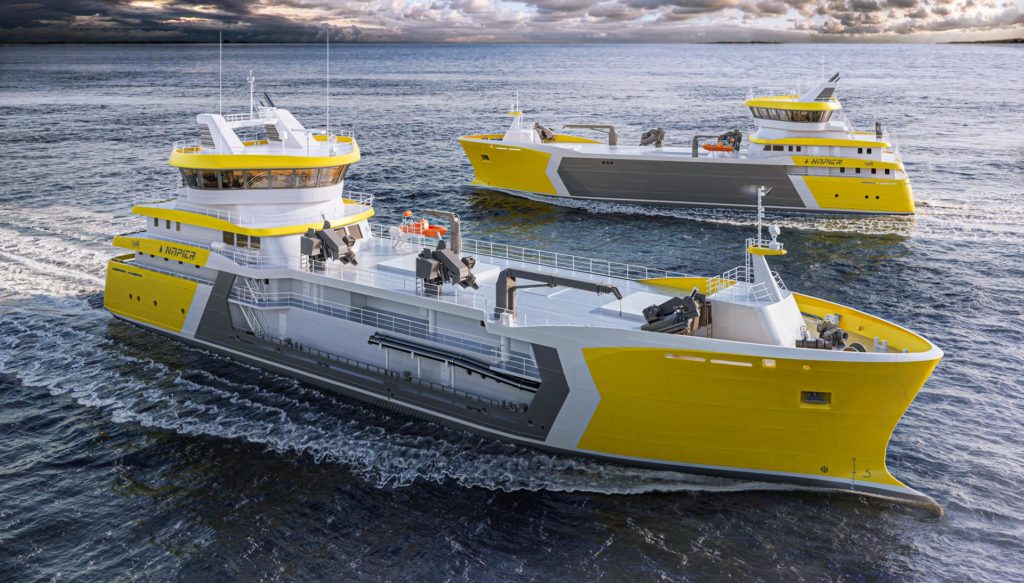
For Mowi’s new factory on Jøsnøya, Napier has been awarded a contract to deliver two new processing vessels. They will stun and transport harvest-ready fish from sea cages in Central Norway to the factory.
“We have collaborated closely and successfully with Mowi since 2008, and view the new agreement as recognition of the concept and how Napier performs stunning at the cage edge,” says Kjetil Tufteland, CEO of Napier.
Sees Major Advantages
Tufteland is proud of the new contract and believes the advantages of using processing vessels are numerous.
“The use of processing vessels is beneficial for fish welfare, and the technology also represents a far better alternative for disease-secure transport,” he says. Tufteland also refers to the Norwegian Food Safety Authority’s clarification of principles in 2021, where the Authority concluded that the risk of disease transmission from stunning vessels is lower than from wellboats.
When using processing vessels, the fish is euthanized immediately upon boarding the vessel, which reduces handling while simultaneously eliminating transport stress and mortality to the slaughterhouse. The vessel is completely closed, with no exchange of water or contact with the sea. There are also separate loading and unloading systems, which eliminates contact between the harvest fish and the fish still in the cages at the sea farms.
“Major Advancement”
The contract with Mowi was the catalyst for Napier now ordering two new processing vessels. With a length of 70 meters and a width of 15 meters, the ships will be the largest in the shipping company’s fleet—which currently numbers four vessels.
“Through innovation and development, Napier shall be in constant forward motion for our customers, and the next newbuilds represent a major advancement. Both for our business concept, but also for the entire organization—as we will need 50 new Norwegian seafarers to crew the ships,” says Tufteland. Napier currently has approximately 70 employees.
The new sister ships are designed by Salt Ship Design in Stord and will be built at Sefine Shipyard in Turkey. The goal is to put both into operation in 2024. The ships will have the capacity to load and stun 200 tons of salmon per hour. The tanks with chilled seawater have space for approximately 750 tons of fish during the closed transport between cage and slaughterhouse.
Reduced Climate Footprint
“The vessel size and dimensions of the fish handling facility provide us with significantly greater loading and stunning capacity than we have in our current fleet. Like our existing vessels, the newbuilds and processes on board are also designed for the highest possible degree of fish welfare. We have an ethical responsibility to give the fish the best possible conditions on its final journey. At the same time, good fish welfare with minimal stress also results in better quality of the fish meat, which is naturally a major advantage for our customers,” explains Kåre A. Cederström, Quality Manager and Aquaculture Biologist at Napier.
He further notes that processing vessels have 75 percent fish in the tanks on each transport. This makes the vessels market-leading for climate and environmental emissions per kilogram of farmed fish transported. Since they do not need to transport large quantities of water for the fish to swim in during the journey, processing vessels can be built smaller than traditional wellboats. This results in significantly lower fuel consumption and reduced climate and environmental footprint.
“During the actual transport phase, the energy-efficient newbuilds will transport 5.3 tons of salmon per liter of diesel consumed, a clear improvement from our existing vessels. The ships will also utilize shore power during the unloading of fish at the slaughterhouse, which is expected to reduce fuel consumption by approximately 200,000 liters of diesel per year per ship,” Cederström points out.
Technology Development Increases Biosecurity
For the handling of fish on board, both ships will be equipped with the finest technology in a fish package delivered by skilled main partners MMC and Baader. Based on shared operational experience with Mowi since 2008, Napier has worked together with system suppliers and research environments such as Sintef and Nofima on further development of the stunning, washing, and cleaning systems on board.
“Our employees’ extensive experience and knowledge of the systems, together with our ability to implement incremental improvements through continuous operation, have contributed to important technological advancements for our stunning boat concept. We see the results in the form of improved fish welfare for farmed fish. With hermetically sealed transport, we also achieve increased biosecurity—where the risk of spreading potential disease to both farmed and wild fish is reduced,” says the aquaculture biologist.
Napier in Brief
Through solid seamanship, high biological and process competence, and a commitment to continuous innovation and development, Napier safeguards customers’ assets—all the way from cage to slaughterhouse. After starting as a wellboat operator in 1995, Napier became Norway’s first pure processing boat shipping company in 2008. The company is today the leading player in this market, with four stunning vessels all operating on long-term contracts for Norwegian fish farmers. The shipping company has 70 employees and headquarters in Bømlo.
Facts: Napier’s Processing Vessels
- While traditional wellboats transport live fish to slaughterhouses, a processing vessel loads and euthanizes (stuns) the fish at the fish farm.
- The fish is then directed to tanks with chilled and UV-treated seawater, before hermetically sealed and biosecure transport to the slaughterhouse
- Use of stunning boats provides:
- reduced stress in fish, improved fish welfare
- reduced risk in the transport stage, no mortality during transport or in holding cages
- higher transport efficiency, lower emissions per kilogram of fish transported
- reduced risk of disease transmission to farmed and wild fish
