

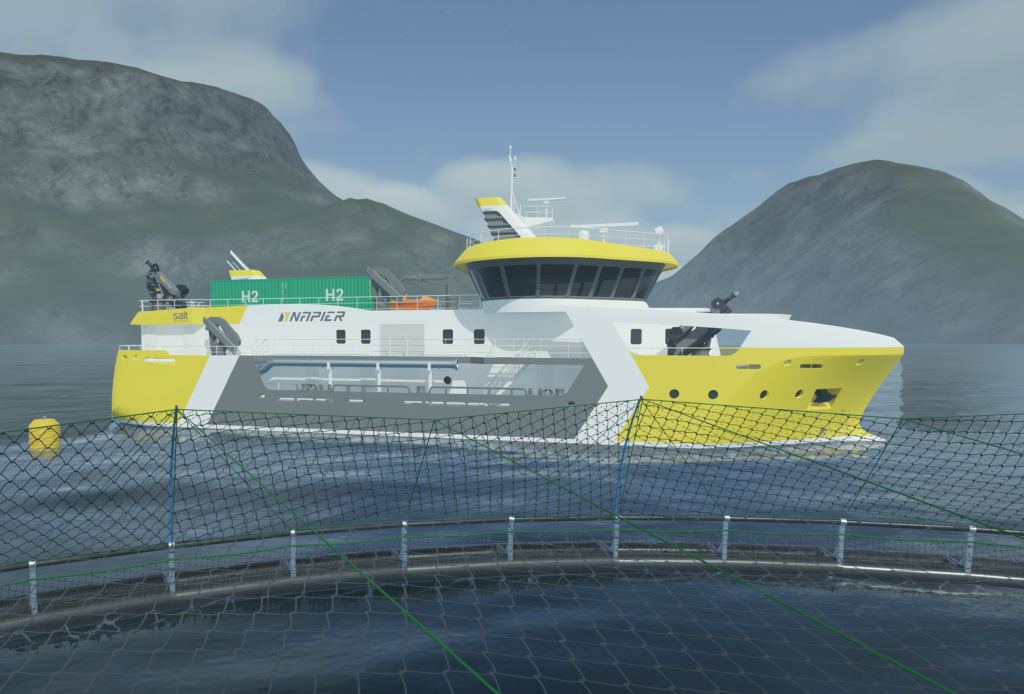
Paves the Way for Construction of Zero-Emission Processing Vessel
ENOVA has awarded Napier 123 million NOK in investment support for the realization of the shipping company’s new hydrogen-powered processing vessel. “With this vessel, we can also offer our customers zero-emission ships, and continue to leave our mark on the industry for the future,” says Kjetil Tufteland, CEO of Napier.
Napier has been a pioneer in the processing vessel industry since 2008, and with specialized expertise and solid operational experience, has shaped an entire industry with its innovative solutions for the bleeding and transport of farmed fish. Over the past year, the shipping company and a group of partners have developed a hydrogen-powered vessel that enables improved fish welfare, zero biological emissions to the sea, and zero emissions to the air—all in one ship. On Wednesday, it was announced that ENOVA has awarded the new concept vessel a full 123 million NOK in investment grants from the “Hydrogen in Vessels” support program.
Important Contribution
“This is a great day for us at Napier. The investment support is an important and significant contribution to realizing a groundbreaking vessel that is currently not otherwise economically sustainable to order. We are therefore very pleased to have the opportunity to develop and realize the project further through this award,” says Kjetil Tufteland, CEO of Napier.
He emphasizes three criteria that will be decisive in the future transport of farmed fish: Enhanced fish welfare, high biosecurity, and zero greenhouse gas emissions.
“We have already established fish welfare and biosecurity in our existing fleet and operational model, where we have followed our own path in terms of innovation for many years. With the new hydrogen-powered vessel, we can also offer our customers zero-emission vessels, thereby continuing to shape the industry for the future. The new vessel concept underpins the company’s values, which are based on a restless pursuit of improvements in sustainable transport on the fish’s terms,” Tufteland states.
Has Interested Parties
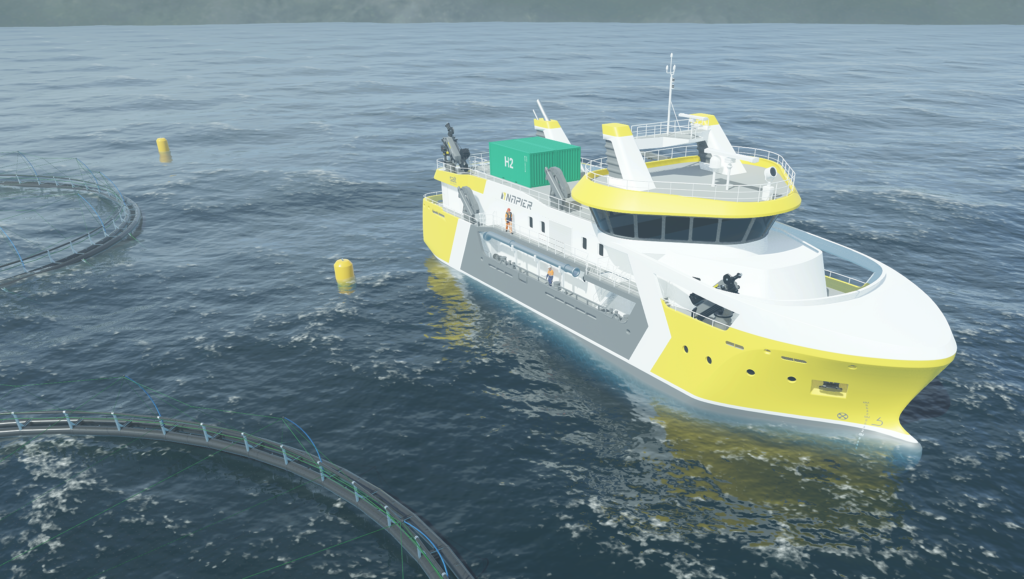
Napier’s new generation vessel will be a ship of approximately 50 meters, with a propulsion solution that uses compressed hydrogen as fuel in combination with battery technology. The concept is the result of close collaboration between Napier’s own experts, Salt Ship Design, Norwegian Hydrogen, LH2 Shipping, and the Green Shipping Program (DNV). The vessel will have a cargo capacity of approximately 300 tons, making it suitable for the majority of Norwegian aquaculture companies.
“We are in dialogue with several fish farmers who are interested in utilizing the new concept, and we naturally wish to get in touch with more actors who want to sell their products with a reduced footprint. This is a concept for players who want to lead the development of more sustainable aquaculture, where logistics is naturally a significant part of the value chain. We hope to see the ship delivered during 2027,” says Tufteland.
When using processing vessels, the fish is euthanized already at the cage edge, shortly after being loaded on board. The fish swims through a counter-current basin and through fully automated bleeding machines, where the fish is euthanized before being transported onward to the processing plant in a chilled state. Each ship can thus transport fish more efficiently compared to transport of live fish, which requires hauling large quantities of water. This means smaller vessels can be used to transport the same quantity of fish—which already provides approximately 50% reduction in greenhouse gas emissions compared to vessels for live transport, before the hydrogen option now enters the picture.
Shipping Company with Tailwinds
Jahn Helge Bjørnestad, Chief Commercial Officer at Napier, also emphasizes transport of farmed fish as ideal for hydrogen propulsion and zero emissions.
“Our ships have an operational profile with relatively fixed regional routes and frequent calls at established processing plants. This allows us to both refill hydrogen and charge the battery pack while docked for unloading and cleaning. Other types of vessels often have less regularity in their operational profile, a much greater power requirement, and may not have the same bunkering opportunities. From an infrastructure perspective, the timing is also relevant, as ENOVA’s new call for support for the development of hydrogen production for maritime transport is also expected to be clarified during the autumn,” Bjørnestad explains.
The good news from ENOVA provides new inspiration to a shipping company with tailwinds. Napier already has a fleet of four processing vessels operating on fixed contracts along the entire Norwegian coast, and two new ships are under construction. These two will be the world’s largest processing vessels, and will transport fish to aquaculture giant MOWI’s brand new facility at Jøsnøya in Trøndelag.
For further information, please contact:
Kjetil Tufteland, CEO
Tel.: 906 49 083
Email: Kjetil@napier.no
Jahn Helge Bjørnestad, CCO
Tel: 934 89 239
Email: jhb@napier.no
Napier in Brief
Through solid seamanship, high biological and processing expertise, and a commitment to continuous innovation and development, Napier safeguards customers’ values—all the way from cage to processing plant. After starting as a wellboat operator in 1995, Napier became Norway’s first shipping company for processing vessels (bleeding vessels) in 2008. The company is today the leading operator in this market, with four vessels all operating on long-term contracts for Norwegian fish farmers and two new ships under construction. The shipping company has its headquarters in Bømlo and will employ approximately 130 people after delivery of the two newbuilds.
